
If you could only keep one product in your skincare routine, it should be sunscreen. It's the factor that has the most impact on skin aging, dark spots, and long-term skin health.
Yet it's the step most often neglected — especially daily, when you're not going "to the beach." This guide explains why daily sun protection is essential, and how to choose a product you'll actually want to wear every day.
Why wear sunscreen every day
UV rays pass through clouds
Even on overcast days, 80% of UV rays reach the surface. Gray skies don't protect your skin.
UV rays pass through windows
UVA rays — those that cause aging and dark spots — pass through glass. If you work near a window, your skin is exposed.
The sun is the #1 cause of skin aging
Studies estimate that 80 to 90% of visible skin aging (wrinkles, spots, sagging) is caused by UV rays, not chronological age. This is called photoaging.
In Morocco, it's particularly important
Sunlight in Morocco is among the most intense in the world. Even in winter, the UV index can reach 4-5, a level that causes cumulative damage. In summer, it regularly exceeds 10-11.
SPF: What does it really mean?
SPF (Sun Protection Factor) measures protection against UVB — rays that cause sunburn.
- SPF 30: blocks ~97% of UVB
- SPF 50: blocks ~98% of UVB
- SPF 100: blocks ~99% of UVB
The difference between SPF 30 and 50 seems minimal (97 vs 98%), but in terms of rays that get through, SPF 50 lets through half as many rays as SPF 30. For exposure to Moroccan sun, SPF 50 is the recommended minimum.
Important: SPF does NOT measure protection against UVA (aging, spots). Look for PA++++ (Korean system), the UVA symbol in a circle (European system), or "broad spectrum."
Chemical filters vs mineral filters
Chemical filters (organic)
How it works: absorb UV rays and convert them to heat Advantages: lightweight texture, invisible, no white cast Disadvantages: may irritate sensitive skin, some are controversial (oxybenzone) Examples: octisalate, homosalate, avobenzone, Tinosorb S/M
Mineral filters (inorganic)
How it works: reflect UV rays like a mirror Advantages: well-tolerated, effective immediately Disadvantages: possible white cast, sometimes thick texture Examples: zinc oxide, titanium dioxide
The Korean approach
Korean sunscreens often use next-generation filters (Tinosorb, Uvinul A Plus) that combine high protection, good tolerance, and elegant textures. This is why K-beauty sunscreens have a reputation for comfort that Western products struggle to match.
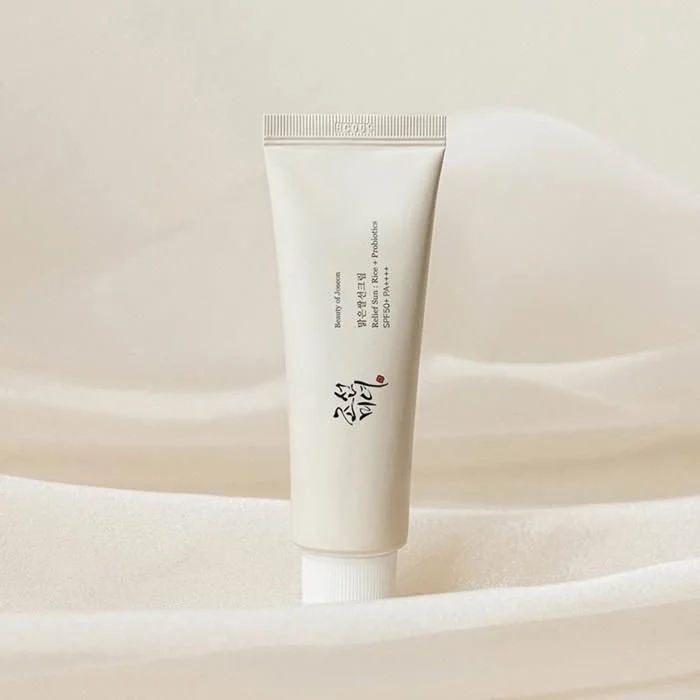
The Beauty of Joseon Relief Sun SPF50+ illustrates this approach: an SPF 50+ PA++++ with a fluid texture that melts into skin, formulated with rice and propolis for skincare benefits beyond protection.
For an even lighter alternative, the Beauty of Joseon Relief Sun: Aqua-fresh offers a watery texture ideal for oily skin in Morocco's climate.
How to choose well
For oily skin
- Fluid or gel texture
- Non-comedogenic formulation
- Matte or semi-matte finish
- Korean sunscreens excel in this category
For dry skin
- Cream texture with hydrating ingredients
- Formulation enriched in HA or ceramides
- Avoid finishes too matte that emphasize dry areas
For sensitive skin
- Mineral filters or next-generation chemical filters
- Fragrance-free, alcohol-free
- Purito is known for gentle sunscreens
For daily urban life in Morocco
- SPF 50 PA++++ minimum
- Lightweight texture that works under or without makeup
- Reapplication possible (compact format or spray)
Reapplication: The crucial point
Sunscreen loses its effectiveness over time — due to sweat, sebum, friction. The rule:
- Reapply every 2 hours during direct sun exposure
- Reapply after 4-5 hours for daily urban exposure
- Reapply after swimming or intense sweating
For reapplication, cushion SPF and Korean sunscreen sprays are practical — they apply over makeup.
Common mistakes
Not using enough product. The standard amount is 1/4 teaspoon for the face. Most people use half that, which drastically reduces protection.
Forgetting the neck and ears. These areas are exposed and age too.
Considering makeup with SPF as sufficient. An SPF 15 foundation doesn't provide adequate protection — the amount applied is far less than a dedicated sunscreen.
Check our detailed article on Korean sunscreen in Morocco for a comparison of K-beauty sunscreens.
FAQ
What's the difference between SPF 30 and SPF 50? SPF 30 lets through 3.3% of UVB, SPF 50 lets through 2%. It seems minimal, but SPF 50 blocks 50% more rays than SPF 30. In Morocco, with intense sunlight, SPF 50 is recommended.
Should I wear sunscreen even in winter? Yes. UVA rays (aging, spots) are present year-round, even on cloudy days. In Morocco, the UV index remains significant even in winter.
Chemical or mineral filter: which should I choose? Next-generation chemical filters offer the best compromise between protection and comfort. Mineral filters are preferable for very sensitive skin or children. Both are effective — the best sunscreen is one you actually wear every day.
Discover Beauty of Joseon products or explore the Korean skincare guide for Morocco.
