
Hyaluronic acid (HA) is ubiquitous in modern skincare. And for good reason: this molecule can retain up to 1,000 times its weight in water. But not all hyaluronic acid products are created equal.
Molecule size, concentration, formulation, and even how you apply it dramatically change its effectiveness. This guide details what you need to know to get the most out of it.
What is Hyaluronic Acid?
Hyaluronic acid is a glycosaminoglycan — a sugar naturally present in skin, joints, and eyes. In the skin, it plays an essential role in water retention and volume maintenance.
With age, natural HA production decreases. This is one of the reasons why skin loses firmness and hydration over time.
In skincare, HA is used topically (serums, creams, essences) to compensate for this loss and strengthen skin hydration.
High Molecular Weight vs Low Molecular Weight
This is the distinction that matters. The size of the HA molecule determines its penetration and action:
High Molecular Weight (> 1,000 kDa)
- Remains on the skin surface
- Forms a hydrating film that prevents dehydration
- Immediate but temporary plumping effect
- Well tolerated, no risk of irritation
Medium Molecular Weight (100-1,000 kDa)
- Partially penetrates the epidermis
- Hydrates superficial and middle layers
- Good balance of effectiveness and comfort
Low Molecular Weight (< 100 kDa)
- Penetrates deeper into the dermis
- Deep and long-lasting hydration
- May be slightly irritating on very sensitive skin
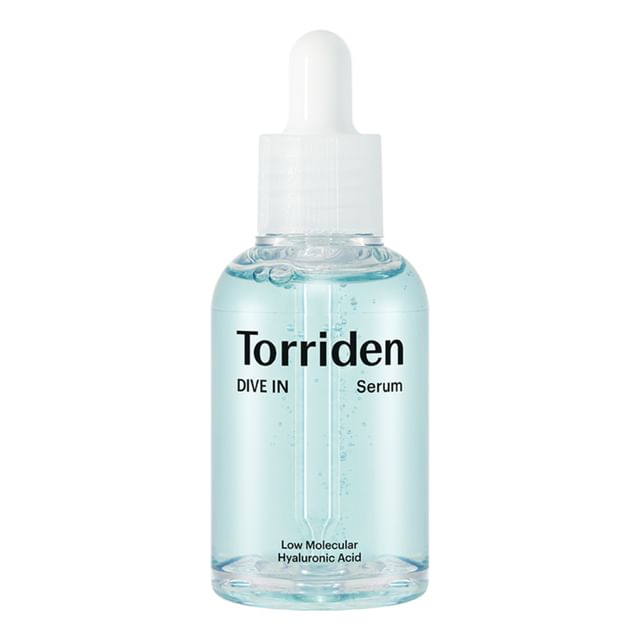
The best products combine multiple molecular weights to work at all skin levels. This is the approach favored by Korean brands like Torriden, whose Dive-In Serum uses 5 types of HA in different sizes.
How to Apply Hyaluronic Acid Correctly
A detail many overlook: hyaluronic acid must be applied to damp skin.
HA is a humectant — it attracts water. If you apply it to dry skin in a dry environment, it will seek water wherever it finds it: in the deep layers of your skin. Paradoxical result: your skin becomes dehydrated.
The Right Method:
- Cleanse your skin
- Without drying it completely, apply your hydrating toner
- On still-damp skin, apply your hyaluronic acid serum
- Immediately seal with a hydrating cream or oil
This "layering on damp skin" technique is a cornerstone of Korean skincare, and it makes all the difference with hyaluronic acid.
Hyaluronic Acid in Korean Skincare
Korean brands pioneered the multi-molecular use of HA. Here are the most notable approaches:
- [COSRX](/brand/cosrx) offers well-formulated and affordably priced hyaluronic acid serums and toners
- [SKIN1004](/brand/skin1004) often combines HA and centella for soothing hydration
- [Anua](/brand/anua) incorporates HA into its Heartleaf formulations for reactive skin
Hyaluronic Acid and Morocco's Climate
Morocco's climate can be a challenge for skin hydration. In summer, heat and sun intensify dehydration. In winter, wind and indoor heating dry the air.
Hyaluronic acid is particularly useful in this context, but it must always be sealed under an occlusive or semi-occlusive cream. HA alone, without a protective layer on top, will be less effective in dry climates.
For dehydrated skin, the combination HA + rich hydrating cream is the basic combination to master.
Effective Combinations
- HA + niacinamide: hydration + sebum regulation → perfect for combination skin
- HA + centella: hydration + soothing → ideal for sensitive skin
- HA + vitamin C: hydration + radiance → antioxidant morning routine
- HA + ceramides: hydration + barrier strengthening → the two pillars of skin repair
FAQ
Is hyaluronic acid suitable for oily skin? Yes. HA is lightweight, non-comedogenic, and indirectly regulates sebum production by maintaining good hydration. Oily skin that lacks hydration overproduces sebum as compensation — HA helps break this cycle.
Low or high molecular weight: what's the difference? High molecular weight stays on the surface and hydrates instantly. Low molecular weight penetrates deeper for lasting hydration. The best products combine both.
Should hyaluronic acid be applied to damp skin? Yes, it's essential. HA attracts water — on damp skin, it captures surface water. On dry skin, it risks drawing water from deep layers, worsening dehydration.
Discover care for dehydrated vs dry skin or consult our guide on Korean skincare in Morocco.